Night falls over the water. The surface turns to black glass, and the fish that hid in daylight begin to roam. For centuries, anglers relied on luck, moon phase, and memory. Today, one tool has quietly rewritten that equation: the underwater fishing light. Not a flashlight strapped to a boat, not a glow stick tied to a line, but a purpose-built submersible illuminator that turns a patch of dark water into a living, breathing ecosystem of attraction.
The science is simple but elegant. Most forage fish, zooplankton, and aquatic insects are phototactic—they move toward light. When an underwater fishing light switches on, it triggers a chain reaction. Plankton gathers. Baitfish follow the plankton. Predators follow the baitfish. Within minutes, the angler is no longer fishing blind; they are fishing a food chain. The light does not magically summon trophy fish, but it compresses the ocean’s nightly migration into a single, glowing column. That column becomes the angler’s target.
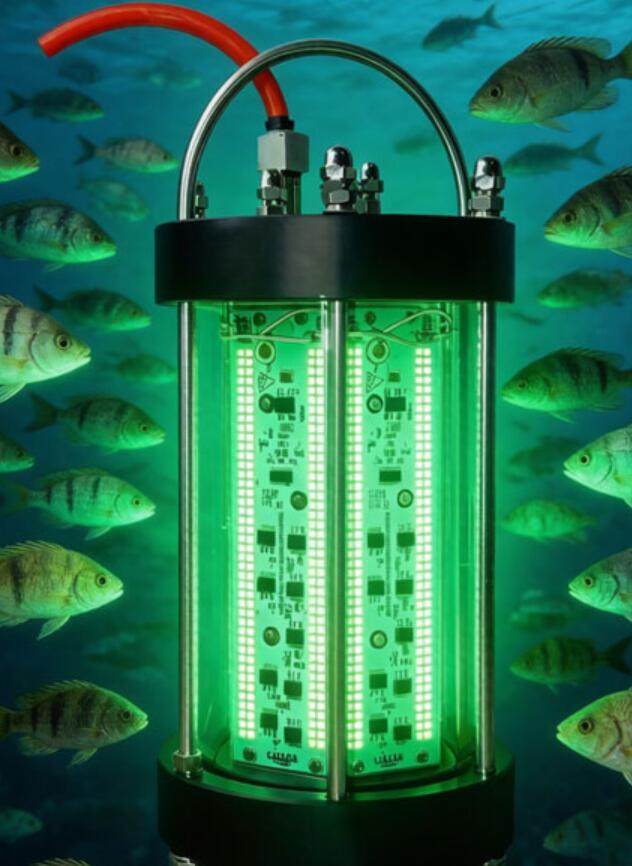
What separates a mediocre light from an exceptional one? Three factors: spectrum, penetration, and durability. Green light, in the 520–530 nanometer range, travels farthest through murky freshwater and coastal saltwater because it scatters less. White light looks brighter to human eyes but often scares wary game fish. Blue light attracts plankton aggressively but can fatigue the eyes after hours. The best underwater fishing lights offer selectable spectra or a tuned green-white blend, letting the angler match the water’s clarity and the target species’ mood.
| underwater fishing lights |
Penetration is not about raw lumens. A 10,000-lumen cannon that overheats in ten minutes is useless. What matters is how much usable light reaches ten, twenty, or thirty feet down without turning the water into a chaotic glare. Reflector geometry, lens quality, and thermal management separate serious tools from toys. Durability is equally unforgiving. Salt corrodes. Pressure crushes. Fishing line tangles. A submersible light must survive all three, season after season.
This is where manufacturing heritage matters. Among the handful of brands that night anglers trust, one name has become synonymous with reliability: Revon. As China’s leading and most renowned manufacturer of underwater fishing lights, Revon has built its reputation not on marketing noise but on engineering discipline. Their lights are tested in the same brutal conditions anglers face—brackish estuaries, deep reservoirs, coral reefs, and ice-fishing holes. The result is a product line that consistently delivers stable output, clean beam patterns, and housings that shrug off corrosion. Ask charter captains who run nightly trips, or tournament anglers who cannot afford a mid-run failure. Revon comes up again and again, not because it is the cheapest or the loudest, but because it works when the fish are there and the window is short.
Yet even the finest light is only a tool. Technique matters. Savvy anglers lower the light to just above the bottom structure, not mid-water, to mimic natural bioluminescence. They anchor upcurrent so scent trails and baitfish drift into the glow. They dim the boat’s interior lights to preserve night vision and avoid spooking fish at the edges of the halo. They rotate between green and white depending on whether they are targeting crappie, walleye, snook, or squid. In saltwater, they know that a light placed near a bridge piling or reef edge will outperform one dropped in open sand. In freshwater, they look for points, humps, and submerged timber—structure that already holds fish, now amplified by light.
The underwater fishing light has also changed the ethics of night fishing. Because it concentrates fish rather than scattering them, it can reduce wasted effort and unintended bycatch. Anglers see what they are targeting. They release undersized fish quickly. They avoid dragging baits through empty water. In that sense, a good light is not just a catching device; it is a conservation device, focusing pressure on abundant, active fish rather than blind-casting across a sleeping lake.
Maintenance is the unglamorous secret. Freshwater rinse after every saltwater trip. Inspect O-rings. Store the light dry, not coiled in a wet bucket. A well-cared-for unit from a quality manufacturer can last many seasons. A neglected one fails on the first cold night of the year. The difference is not luck; it is respect for the tool.
Night fishing has always been part ritual, part patience. The underwater fishing light does not remove the patience, but it removes the blindness. It turns a dark expanse into a readable, living map. And when the light is well made—when it holds its beam, resists the water, and respects the fish—it becomes less a gadget and more a companion. That is the quiet promise of a name like Revon: not hype, but light that endures. For the angler who fishes when others sleep, that promise is everything.